

Commentary
Alexander Baunov
{
  "authors": [
    "Alexander Baunov"
  ],
  "type": "commentary",
  "blog": "Carnegie Politika",
  "centerAffiliationAll": "",
  "centers": [
    "Carnegie Endowment for International Peace",
    "Carnegie Russia Eurasia Center"
  ],
  "englishNewsletterAll": "",
  "nonEnglishNewsletterAll": "",
  "primaryCenter": "Carnegie Russia Eurasia Center",
  "programAffiliation": "",
  "regions": [
    "Europe",
    "Western Balkans"
  ],
  "topics": [
    "Political Reform",
    "Civil Society",
    "EU",
    "Domestic Politics"
  ]
}
Source: Getty
Serbia’s electoral earthquake is an extremely rare example of an entire political system being defeated by street protesters who played by the rules.
Aleksandar Vučić’s Serbian Progressive Party (SNS), which had ruled Serbia for fourteen years, lost parliamentary elections on October 25 to the Student List movement. Student List succeeded in uniting both liberals and nationalists behind demands for good governance—and did not enjoy the backing of oligarchs, elite defectors, or the West. Indeed, these elections have provided one of the first examples of street protesters peacefully entering a state’s existing institutional framework instead of destroying it. Now Student List will need to show that a strong protest movement can govern effectively.
No other parties apart from SNS (with 39.3 percent of the vote) and Student List (52.5 percent) cleared the 3 percent threshold required to enter parliament. But this was not the victory of a pro-Europe democratic opposition over a nascent anti-Europe autocracy. It was the victory of a horizontal network over a vertical one. A grassroots initiative fielding political unknowns beat both Vučić, who has been in politics since the 1990s, and established political parties.
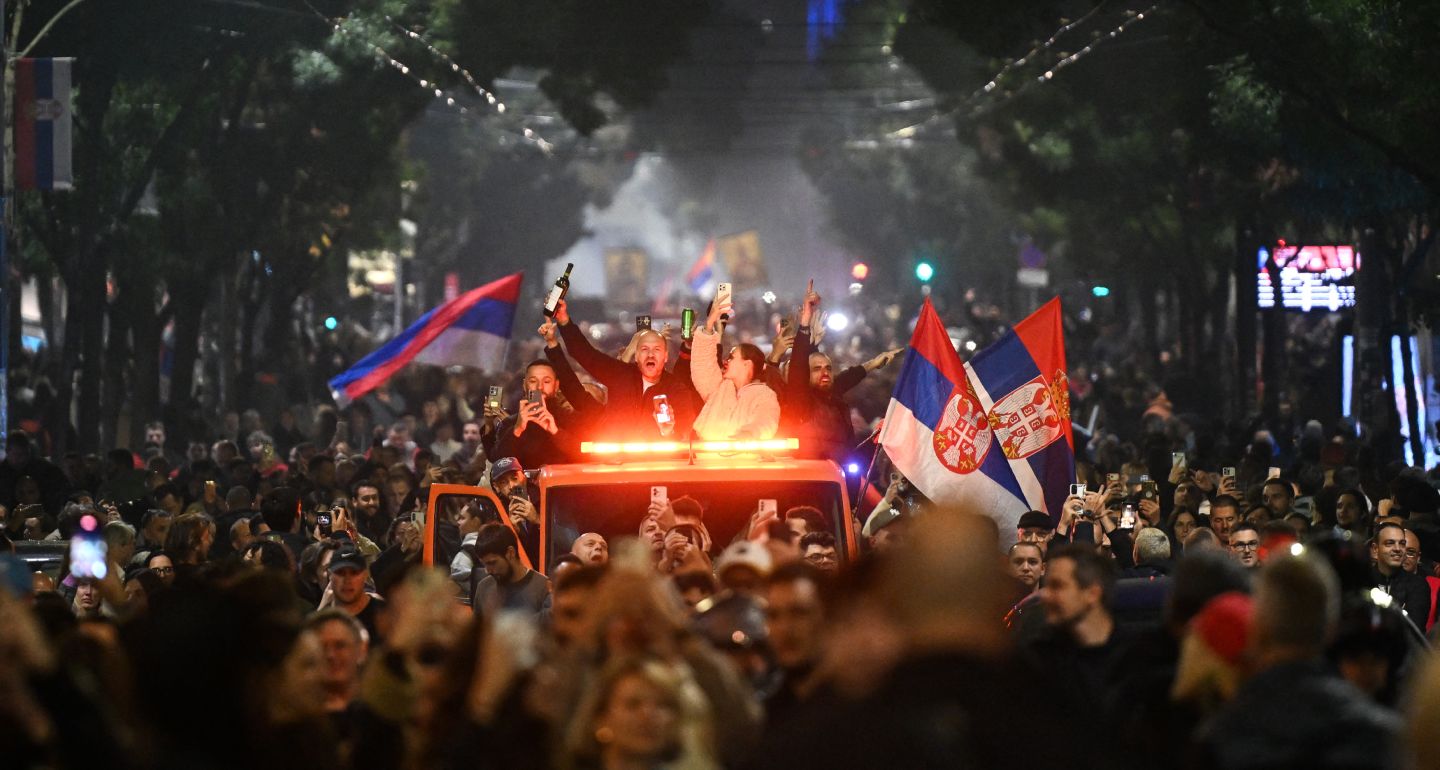
Nor was it the triumph of one group of politicians over another: It was a popular victory over politicians as a whole. Celebrations in Belgrade in the small hours of October 26 brought people together rather than dividing them—and felt more like Serbia had scored the winning goal at the World Cup.
The extremely high turnout added to the sense that this was a victory for the people. Initial figures put turnout at about 70 percent (excluding votes cast by the diaspora), which was as much as 15 percentage points higher than in previous votes. By comparison, turnout in the presidential election in neighboring Bulgaria on the same day was just 22.5 percent.
From the very beginning, it was a point of principle for Serbia’s students to show that they were not interested in acquiring power for themselves. Their list of 250 candidates took over a year to compile and excluded both protest organizers and professional politicians. Instead, places were given to professors trusted by the students and public figures from sports, economics, and healthcare. The lead candidate was Ilija Srdanović, a professor of medicine.
In some ways, the victory resembled that of Servant of the People—the group of political unknowns that pushed aside established parties to win Ukraine’s 2019 parliamentary election. However, in that case, the party was loyal to sitting President Volodymyr Zelensky.
Unlike other cases when newcomers have overturned an established system, Serbia’s Student List did not have any oligarchic backers. The nature of Serbia’s economy means that it does not have an oligarchy like that in Ukraine or Russia, and has more in common with other Central and Eastern European nations.
Nor was the movement run by disillusioned functionaries or members of an old elite. This was very different to when Viktor Orbán lost parliamentary elections in Hungary in April this year and was replaced as prime minister by Péter Magyar, an ex-member of the ruling party.
Serbia has not been divided into two camps —unlike Ukraine’s 2014 Maidan protests. In Serbia, there was not a pro-Europe side and, so to speak, a pro-Moscow one. Student List avoided building its campaign around dichotomies, whether pro-Europe/anti-Europe, or conservative/progressive. Instead, it contrasted good governance with bad governance, much like the frescoes of Ambrogio Lorenzetti in Siena.
Demands to combat corruption, use state funds efficiently, manage the economy effectively, and develop infrastructure (the student protest movement began after the collapse of a concrete canopy at Novi Sad railway station in 2024 killed sixteen people) united all those unhappy with Serbia’s political class. The approach helped overcome the traditional divide within the Serbian opposition between pro-Europe liberals and conservative nationalists, who were all dissatisfied with Vučić but could not agree among themselves.
These two groups continue to coexist within the movement. When speakers at a protest on June 28, 2025, used nationalist rhetoric and promoted myths about Kosovo, it irritated liberals, but no one prominent abandoned the movement. The Student List passed a memorandum in 2026 stating that Kosovo was part of Serbia, but it also organized sporting events in Strasbourg and Brussels and met with European Union officials. In this sense, the victors in Serbia resemble the liberal-nationalist coalitions that have won elections in post-Communist countries, from Poland and the Balkans to Russia, Georgia, and Ukraine.
Once again, the most important lesson from the electoral earthquake in Serbia is not that an autocrat was defeated, but that the victors were street protesters who agreed to play by the institutional rules.
It is the culmination of more than two years of work. The shock following the deaths in Novi Sad led to the airing of grievances and then demands. But those Serbs who were unhappy did not simply complain; they started taking action. That action was not a flash in the pan—it continued for years. Horizontal protests are often short-lived (take the anti-Kremlin demonstrations in Russia in 2011 and 2012, or the Yellow Vest protests in France). The fact that the Serbian opposition movement had managed to become something more permanent was already a major achievement.
The most important moment, however, was when that movement found a way to exist within the country’s institutional framework instead of trying to tear it down. The protesters made Serbia’s institutions work for them.
The transfer of power in Belgrade took place not because of the threat of a revolution or coup d’état (as after Benito Mussolini’s march on Rome in 1922), foreign pressure (as with Filipino dictator Ferdinand Marcos after a phone call from Washington), a ruler’s fear for their own safety (as with the flight of Ukraine’s then president Viktor Yanukovych in 2014), and certainly not street violence (as with the departure of Charles de Gaulle less than a year after France’s May 1968 protests). What we have witnessed is one of the first instances of a new, horizontal politics peacefully filling an old, vertical structure. The students didn’t choose one politician over another; they stepped forward themselves. Serbia has had its cake and eaten it, too. And, at least for now, all the store windows remain intact.
Senior Fellow, Editor-in-Chief, Carnegie Russia Eurasia Center
Baunov is a senior fellow and editor-in-chief at the Carnegie Russia Eurasia Center.
Recent Work
Alexander Baunov
Alexander Baunov
Carnegie does not take institutional positions on public policy issues; the views represented herein are those of the author(s) and do not necessarily reflect the views of Carnegie, its staff, or its trustees.
The new Serbian leadership may have promised to keep on cooperating with Russia, but soon they will have to make a choice between fighting corruption and sealing lucrative deals with Moscow. The two are mutually exclusive, even if the new leaders in Belgrade haven’t yet realized it.

Maksim Samorukov
The pressures of war are gradually warping Russia’s system of governance, making it more vulnerable to a future crisis.

Tatiana Stanovaya
The truth of the strategic situation is that Europe and Russia are extremely unlikely to be able to “turn the page” on their confrontation within the next two decades.
Arkady Moshes

Russia spent years building a “sovereign internet,” concentrating web infrastructure exclusively within Russian territory. Ukrainian drone attacks have shown how vulnerable that approach has left the Russian internet.

Maria Kolomychenko
Putin’s conservative staffing policies and search for ever greater control have cemented parliament’s transformation into a bureaucratic appendage of the executive branch.
Andrey Pertsev